
Uncategorised
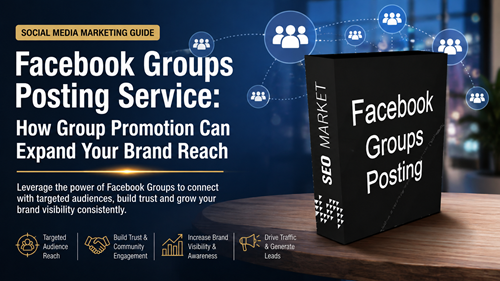
Facebook Groups Posting Service: How Group Promotion Can Expand Your Brand Reach
Oct
Facebook Groups Posting Service is most useful when it is judged against a clear business objective, a transparent method, and evidence that can be checked after the work is completed. This guide is written for ecommerce brands, affiliate marketers, small businesses, digital marketers, online sellers who want to compare the service without confusing activity, third-party metrics, or promotional claims with guaranteed search results.
The decision should begin with the current baseline and the outcome the business actually values. Ask what the provider controls, what depends on search engines or platforms, what requires client input, and what would cause the plan to change. That approach makes Facebook Groups Posting Service easier to evaluate on quality and fit rather than on the size of the package.
How To Evaluate Facebook Groups Posting Service
Facebook Groups are communities with their own administrators, rules, audience norms, and tolerance for promotion. A campaign must evaluate each group individually rather than treating membership count as permission to advertise.
Useful promotion often begins with education, answers, examples, or a relevant offer that fits the discussion. Reusing the same sales message across many unrelated groups increases removal, reporting, and brand-reputation risk.
Track visits and enquiries with appropriate tagged links, but judge group quality by relevance and lead quality rather than raw clicks. Some smaller specialist groups can outperform large general groups.
Scope, Quality, and Evidence
Define the Deliverable
Use Facebook group marketing to test whether the provider can define the deliverable precisely, explain what is included, and show how the work supports the actual audience rather than a generic campaign label.
Verify the Baseline
For Facebook promotion, ask what baseline is recorded before work starts and which evidence will be available afterward. A useful answer should describe source data, method, frequency, and any assumptions that could change the result.
A buyer should be able to explain the tactic in plain language after the proposal call. If the method only makes sense when a proprietary score or vague promise is accepted without evidence, the scope needs more detail.
Inspect Quality Before Scale
Treat social media outreach as a quality checkpoint instead of a sales phrase. Review relevance, ownership, review standards, and whether the tactic remains useful if a third-party metric or platform feature changes.
Connect Activity to the Business
When considering group advertising, connect the activity to a specific page, service, location, or conversion path. This prevents a campaign from producing activity that looks busy but does not support a business objective.
Ask who owns the accounts, content, domains, creative files, tracking setup, and reports created during the engagement. Ownership becomes especially important when a campaign is paused or moved to another provider.
Measure Outcomes Properly
A proposal involving Facebook traffic should include a measurement method. Decide in advance which first-party or platform indicators will show progress, and separate completed tasks from outcomes that no provider directly controls.
Comparison Framework
Compare competing proposals with the same criteria. A smaller transparent scope can be more valuable than a larger package when the smaller plan explains the method, provides evidence, and targets the pages or audiences that matter most.
| Area | What to Review | Evidence to Request |
|---|---|---|
| Group fit | Audience and topic relevance | Read rules and recent posts |
| Permission | Promotion allowed by admins | Document restrictions |
| Message | Useful context before the offer | Avoid repetitive sales copy |
| Cadence | Respect community frequency | No mass flooding |
| Measurement | Tagged links and qualified actions | Lead quality over click count |
A comparison sheet should also record exclusions, client dependencies, cancellation terms, and the time required for approvals. Those operational details often determine whether a theoretically good strategy can actually be implemented.
Implementation and Measurement
Start with a controlled sequence. Establish the baseline, fix obvious blockers, complete the highest-confidence work, verify tracking, and then scale what is producing useful signals. This makes it easier to separate correlation from changes that can reasonably be connected to the campaign.
Pre-Launch Checklist
- Build a vetted group list
- Read each group’s current rules
- Remove groups that ban promotion
- Tailor the message to the discussion
- Limit repeated copy
- Use trackable landing links
- Monitor removals and feedback
- Stop groups that produce poor-fit traffic
Reporting should explain decisions, not just totals. Useful reports show what changed, where the evidence came from, what improved or declined, what remains uncertain, and which action is recommended next.
Use Meta guidance on safety in Facebook Groups as an independent reference point. Meta explains that Community Standards apply in groups and that admin and member behavior affects group quality and enforcement.
Risks and Red Flags
- Guaranteed rankings or fixed outcomes without conditions
- No disclosure of method or representative examples
- Reporting that shows only activity or a single third-party metric
- Assets or accounts that the client cannot access
- No rejection standard for low-quality work
- Scaling before measurement and quality checks are working
Facebook’s Community Standards apply across groups, and admins can impose stricter rules. Repetitive or unwanted promotion can damage accounts and brand trust even when a post technically publishes.
Do not rely on hidden automation, fake profiles, or misleading engagement. A service should disclose how posts are created, which accounts are used, and how group permissions are respected.
For Facebook Groups Posting Service, the safest buying standard is simple: require a method that can be explained, evidence that can be reviewed, and a result framework that does not depend on promises outside the provider’s control.
Choosing The Right Facebook Groups Posting Service
Facebook Groups Posting Service should fit the website’s current stage, audience, risk tolerance, and measurement capability. Choose the proposal that connects deliverables to a clear objective and makes quality visible before the campaign is scaled.
Keep the baseline, samples, approvals, and reports in one place. That documentation makes it easier to judge progress over time and to change direction when search data, platform rules, or business priorities change.
Frequently Asked Questions
What should a Facebook Groups Posting Service verify first?
It should verify group relevance, current admin rules, promotional permissions, account ownership, post frequency, message quality, tracking, and how removals or complaints are handled.
Can Facebook Groups Posting Service guarantee the advertised outcome?
No provider controls search engines, platform algorithms, competitors, user demand, or every implementation dependency. Evaluate controllable deliverables and evidence rather than guaranteed positions or scores.
What evidence should a buyer request before ordering?
Ask for representative samples, baseline data, quality criteria, source transparency where appropriate, reporting examples, and a clear explanation of how weak or unsuitable work is rejected.
How should progress be measured?
Use several indicators together: first-party traffic and conversion data, search visibility, page-level performance, relevant referring domains or platform metrics, and completed technical or content improvements.
What is the most important red flag?
A provider that will not explain its method or relies on guaranteed outcomes creates unnecessary risk. A credible plan should make scope, evidence, ownership, and limitations easy to understand.
